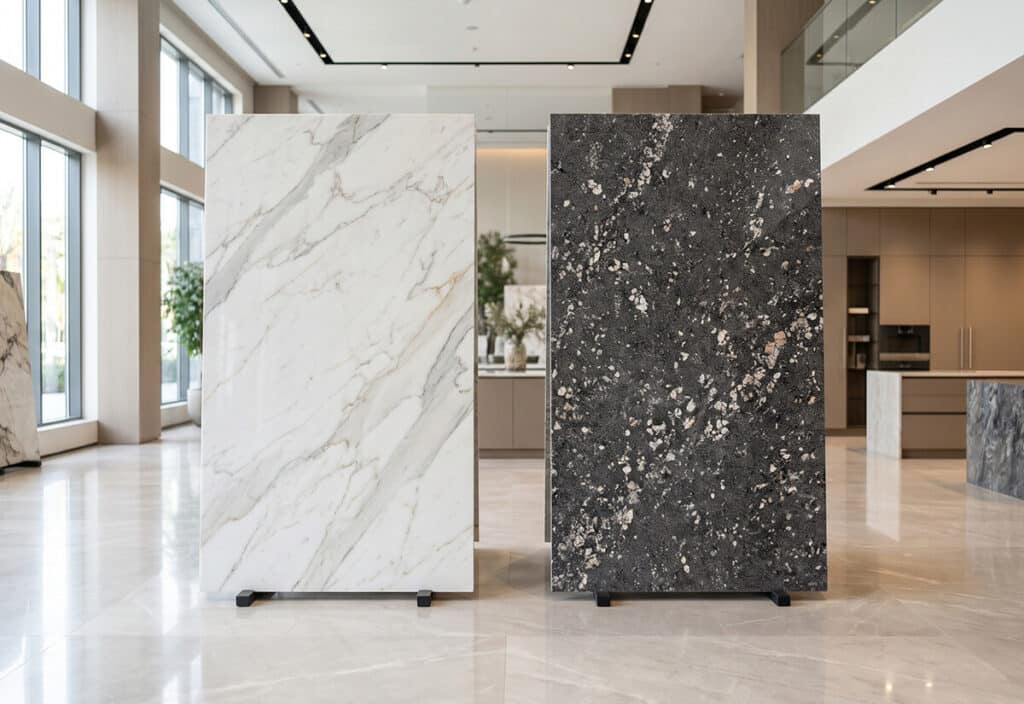
Marble or granite: which is better for flooring? Granite is generally the better choice for kitchens, staircases, and high-traffic areas because of its hardness and scratch resistance. Marble is often preferred for living rooms and bedrooms, where its natural veining and elegant finish create a distinctive appearance.
Both natural stones offer lasting value when selected, installed, and maintained correctly. However, the right choice depends on your home’s design, everyday use, maintenance requirements, and budget.
This guide explores the marble vs granite difference, including durability, appearance, flooring costs, maintenance, and room-wise suitability for Indian homes.
What Is Marble?
Marble is a natural metamorphic stone formed when limestone undergoes heat and pressure. It consists mainly of calcite, although its composition varies. Marble is known for its distinctive veining, smooth texture, and ability to achieve a polished finish.
It is commonly used for living room flooring, bedrooms, decorative walls, and interior spaces where appearance is a priority. Homeowners looking for natural patterns and elegant finishes can explore different options in Sati’s marble collection.
What Is Granite?
Granite is a natural igneous stone formed when molten rock cools and solidifies beneath the Earth’s surface. It primarily contains quartz, feldspar, and other minerals responsible for its colour and crystalline patterns.
Granite is generally harder than marble and more resistant to everyday scratches and abrasion. This makes it a practical flooring option for kitchens, staircases, corridors, and other frequently used areas.
How to Differentiate Marble and Granite?
The easiest way to differentiate marble and granite is by examining their natural patterns, mineral composition, and surface characteristics.
Marble commonly displays flowing veins and softer-looking patterns, while granite often has visible mineral grains, speckles, or crystalline textures. However, some granite varieties also feature flowing patterns, so appearance alone is not always reliable.
Granite is typically harder and more resistant to scratching, whereas calcite-rich marble is more sensitive to acidic substances.
For an accurate identification, consult the stone supplier rather than relying on home scratch or acid tests, which may permanently damage a polished surface.
Marble vs Granite Flooring: Quick Comparison
|
Feature |
Marble | Granite |
| Stone type | Metamorphic |
Igneous |
|
Appearance |
Natural veins and flowing patterns | Speckled, crystalline, or flowing patterns |
|
Hardness |
Generally softer | Generally harder |
| Scratch resistance | More prone to scratches |
Better resistance to abrasion |
|
Acid resistance |
Sensitive to acids |
Generally more resistant |
| Maintenance | Requires more care |
Relatively easier |
|
Best applications |
Living rooms, bedrooms, decorative floors | Kitchens, staircases, high-traffic floors |
| Restoration | Can often be re-polished |
Restoration may require specialist work |
|
Cost |
Depends on variety and origin |
Depends on variety and quality |
Marble vs Granite: 7 Key Differences for Flooring
The marble vs granite flooring comparison goes beyond appearance. Understanding their physical properties helps homeowners choose a suitable material for different applications.
1. Origin and Composition
Marble is a metamorphic rock formed from limestone, generally consisting of calcite or dolomite. Granite is an igneous rock formed through the slow cooling of magma and mainly contains quartz and feldspar.
These differences in mineral composition influence the stones’ hardness, appearance, and reaction to everyday substances.
2. Hardness and Scratch Resistance
Granite generally measures around 6–7 on the Mohs hardness scale, while calcite-rich marble is considerably softer, with calcite measuring approximately 3.
This makes granite more resistant to scratches caused by grit, frequent foot traffic, and everyday household use. Marble may develop surface scratches more easily, especially when furniture is moved without protection.
However, both materials can last for decades with appropriate care.
3. Reaction to Acids and Spills
This is an important distinction for Indian homes, particularly in kitchens and dining areas.
Acidic substances such as lemon juice, vinegar, and tamarind can react with the calcite in marble, causing surface etching. Etching creates dull marks and differs from staining. Even sealed marble can develop etching when exposed to acids.
Granite generally resists household acids better, although certain varieties can absorb oil or other liquids if not adequately protected.
Porosity varies between individual stones, so sealing requirements should be assessed for the selected variety rather than assumed from the stone category alone.
4. Appearance and Natural Patterns
Marble is recognised for its flowing veins, colour variations, and distinctive decorative appeal. These characteristics make it attractive for spacious living rooms and elegant interior designs.
Granite offers a wider range of appearances than commonly assumed, including speckled, uniform, and flowing patterns.
For example, Astoria Ivory Granite features creamy gold tones with brown markings, making it worth exploring for homeowners who prefer warmer natural-stone colours.
5. Finishes and Slip Resistance
Polished marble and granite create smooth, reflective surfaces. However, either material may become slippery when wet.
Honed, brushed, or textured finishes can be considered for areas where additional grip is needed, but actual slip resistance depends on the stone, finish, and surface conditions.
Granite can also be flamed for certain outdoor applications. For bathrooms, balconies, and exterior steps, request appropriate slip-resistance information before selection.
6. Maintenance and Restoration
Both stones should be cleaned using suitable pH-neutral products. Harsh acidic cleaners and abrasive cleaning methods should be avoided.
Marble generally requires more attention because it scratches and etches more easily. Worn marble surfaces can often be professionally honed and re-polished.
Granite usually needs less routine maintenance, although damaged surfaces can also be restored by specialists.
Sealing frequency depends on the stone’s absorption characteristics, finish, sealer, and usage conditions. Not every granite surface requires the same treatment schedule.
7. Long-Term Durability and Value
Granite is generally better suited to areas exposed to frequent movement, grit, and regular cleaning. Marble offers decorative value and can maintain its appearance through appropriate maintenance and occasional restoration.
When comparing long-term value, consider both the initial flooring expense and the care required over the years.
Marble or Granite: Which Is Better for Different Rooms?
Choosing between granite vs marble flooring becomes easier when you consider how each room is used.
| Area | Recommended Stone |
Why |
|
Living Room |
Marble |
Natural veining and reflected light create an elegant appearance |
|
Bedroom |
Marble |
Suitable for relatively low-traffic areas |
|
Kitchen |
Granite |
Better resistance to everyday scratches and acidic spills |
|
Bathroom |
Either, with suitable finish |
Wet-area slip resistance is essential |
|
Staircase |
Granite |
Better resistance to concentrated foot traffic |
|
Entrance/Foyer |
Granite or marble |
Granite handles tracked-in grit better; marble offers decorative appeal |
|
Balcony |
Suitable exterior-grade granite |
Can perform well outdoors with the right finish and installation |
|
Commercial Area |
Granite |
Generally suitable for heavy foot traffic and frequent cleaning |
For living rooms, marble can be an attractive choice when the flooring is a major part of the interior design. However, lighter granite varieties can also create a bright, contemporary appearance.
For kitchens, staircases, and busy entrances, granite is usually more practical. Steel Grey Granite, for example, is described by Sati as suitable for indoor and outdoor flooring applications.
The final selection should also consider finish, slab specifications, installation requirements, and the intended level of use.
Marble vs Granite Flooring Cost in India
Which Is Costlier, Marble or Granite?
Neither marble nor granite is always more expensive. The cost depends on the variety, origin, quality, thickness, finish, and availability.
Standard Indian marble and granite may fall within overlapping price ranges. Imported marble can be considerably more expensive, while premium granite varieties may also command higher prices.
When comparing flooring costs, consider:
- Material price per square foot
- Slab thickness and finishing
- Cutting and installation charges
- Transportation and applicable taxes
- Material wastage and future maintenance
For a fair comparison, request quotations using the same flooring area, material specifications, and installation requirements. A lower material price does not necessarily mean a lower completed flooring cost.
Marble vs Granite: Pros and Cons
Marble Pros
- Unique natural veining and attractive patterns
- Bright appearance, particularly in lighter varieties
- Can often be professionally re-polished to restore its finish
- Suitable for decorative residential interiors
Marble Cons
- More prone to scratches and acid etching
- Requires careful cleaning and prompt spill removal
- Certain premium imported varieties can be expensive
Granite Pros
- High resistance to everyday scratches and abrasion
- Generally easier to maintain
- Available in numerous colours and natural patterns
- Suitable for high-traffic areas and appropriate outdoor applications
Granite Cons
- Some varieties require sealing to reduce staining
- Chips and surface damage may need specialist restoration
- Heavy slabs require appropriate handling and installation
Marble vs Granite vs Tiles: Which Should You Choose?
For homeowners comparing marble vs granite vs tiles, the decision largely depends on natural appearance, maintenance, and budget.
Marble offers distinctive veining and decorative appeal. Granite provides greater resistance to everyday wear, while vitrified tiles offer manufactured finishes in a wide variety of patterns.
|
Factor |
Marble | Granite |
Vitrified Tiles |
|
Material |
Natural stone | Natural stone | Manufactured ceramic |
| Appearance | Unique veining | Natural mineral patterns |
Manufactured designs |
|
Durability |
Good with proper care | Generally high | Depends on tile quality |
| Maintenance | Higher | Relatively low |
Generally low |
|
Price |
Varies widely | Varies widely |
Often budget-friendly |
Vitrified tiles usually do not require surface sealing, while natural stones may need sealing depending on their properties.
Stone-look porcelain or vitrified tiles should not be confused with actual marble or granite tiles cut from natural stone.
For homeowners who value authentic natural patterns, explore the available natural stone varieties before deciding.
How to Choose Between Marble and Granite Flooring
Before finalising your flooring material, consider these five factors.
- Room usage: Granite is generally more suitable for high-traffic spaces, while marble is often preferred for decorative rooms.
- Exposure to spills: Consider granite for areas exposed to acidic foods, grit, or frequent cleaning.
- Maintenance: Choose a material that matches the level of regular care you can manage.
- Total budget: Compare material, installation, transportation, finishing, and future maintenance expenses.
- Slab quality: Inspect the actual stone for natural variation, visible defects, finish quality, and appropriate thickness.
Always review full slabs or representative samples before ordering. Colours and patterns can vary between batches, and the same stone may look different under natural and artificial lighting.
Many homeowners combine both materials, using marble in decorative rooms and granite in more demanding spaces.
Final Verdict: Marble or Granite?
Neither material is the universal winner. Choose granite where durability, frequent use, and easier maintenance matter most. Choose marble where natural veining, elegance, and decorative appeal are the priorities.
The best flooring decision considers room usage, the chosen finish, slab quality, and long-term care rather than appearance alone.
Explore Sati’s natural stone collection to compare granite and marble varieties for your next flooring project.
FAQs About Marble and Granite Flooring
1. Which is more durable, marble or granite?
Granite is generally more durable against everyday scratches and abrasion because it is harder than marble. Both stones can last for many years when installed and maintained correctly.
2. Which is more expensive, marble or granite?
The price depends on the variety, quality, and origin. Standard Indian marble and granite can have overlapping prices, while premium imported marble and speciality granite may cost significantly more.
3. Which is easier to maintain, marble or granite?
Granite is generally easier to maintain because of its hardness and better resistance to many household substances. Marble requires more careful cleaning and protection from acidic spills.
4. Is marble or granite better for living room flooring?
Marble is often preferred for living rooms because of its natural veining and decorative appearance. Granite is another suitable option for busy households seeking greater scratch resistance.
5. Is granite flooring slippery when wet?
Polished granite can become slippery when wet. For bathrooms, balconies, and other wet areas, choose a finish with suitable verified slip resistance.
6. Which is better for Indian homes: marble, granite, or tiles?
Marble suits decorative interiors, granite is generally better for high-traffic areas, and vitrified tiles offer varied designs with relatively low maintenance. The right option depends on room usage and budget.
7. Does granite flooring require sealing?
Some granite varieties benefit from sealing, while others have low absorption and may not need frequent treatment. The appropriate schedule depends on the stone, finish, and sealer used.
8. Can marble and granite be used together in one home?
Yes. Marble can be used in living rooms and bedrooms, while granite can be selected for kitchens, staircases, and busy entrances. Coordinating colours and finishes helps create a consistent interior design.